Managing the Supply Chain
Supply Chain Management
Connecting and integrating all parties of the distribution system in order to satisfy customers
Focuses on
- Procurement
- Logistics
- Inbound logistics (raw materials)
- Outbound logistics (product)
- Third-party logistics
Operations are often the most public and visible aspect of the supply chain
Procurement
Procurement (aka purchasing) is the buying of all materials needed by the organization
- Aim is to obtain items of desired quality in the right quantities at the lowest possible cost
- Companies may be able to make some component parts more economically and efficiently
- Can arrange to lease the item from another company
- What the firm does depends on cost, availibility, and supplier reliability
Managing inventory
Inventory is all raw materials, components, completed or partially completed products, and pieces of equipment a firm uses.
- Finished-goods inventory
- Work-in-process inventory
- Raw materials inventory
Inventory control
| Economic order quantity model | Find the optimum number of items to purchase that will cost the least in the long term (purchasing, shipping, handling) |
| Just-in-time inventory management | Reduces waste as things are delivered just as they are needed. Risky because a supplier/shipment may be late, which holds up your business |
| Material-requirements planning |
Outsourcing
Oursourcing is the contracting of manufacturing or other tasks to independent companies
- Globalization requires supply chain managers to improve speed and balance resources
- Linked with competitive advantage
- May raise negative public opinion
Results in higher risk than being vertically integrated. Control is lost, and you need to determine how to deal with the loss of control.
Routing
The sequence of operations through which the product must pass. The sequence depends on the product specifications.
Basically a set of instructions to produce a product. Typically is designed by the engineering department and implemented by management.
Scheduling
The assignment of required tasks to departments or specific machines, workers, or teams.
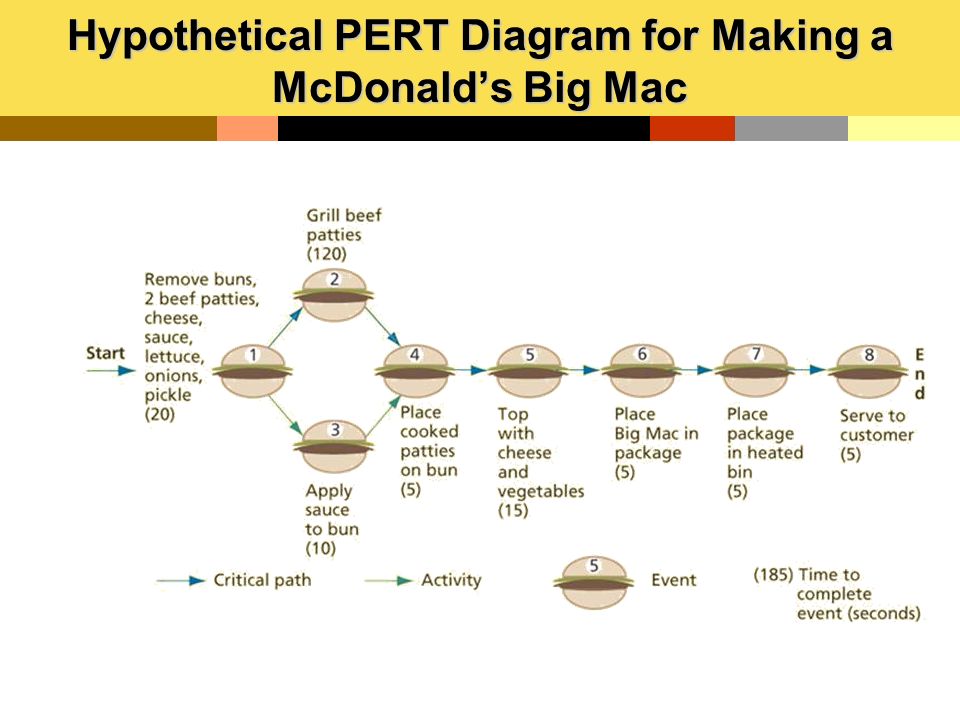
Program Evaluation and Review Technique (PERT)
PERT Identifies all the major activities required to complete a project
- Arranges activities in a sequence or path
- Determines the critical path (Path that requires the longest time from start to finish)
- Estimates the time required for each event